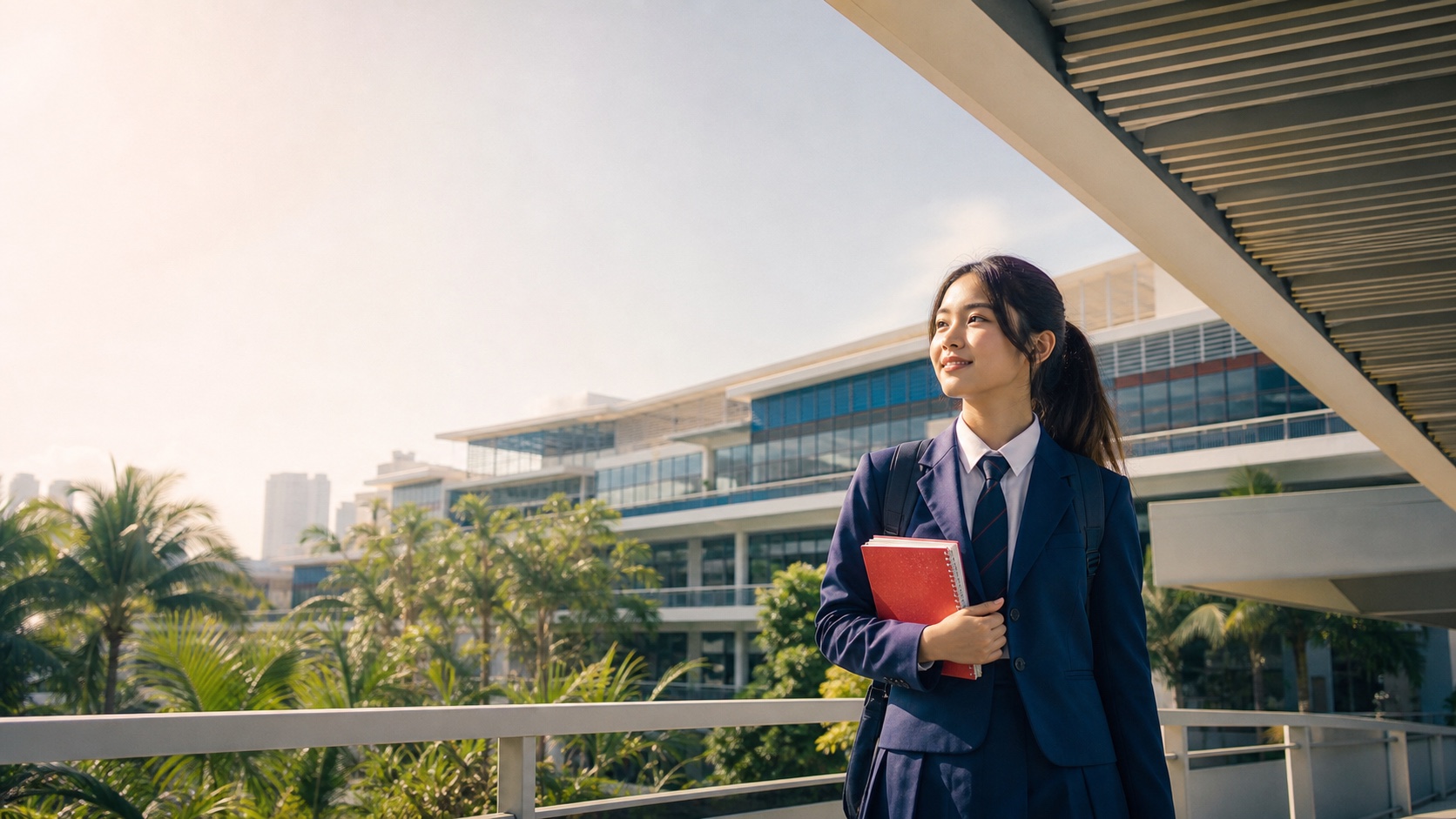
If in the past, parents often waited for their children to finish 12th grade before sending them to study abroad at university in the UK, Australia, or the US, the current trend has shifted strongly to studying abroad in high school in Singapore.
Not only is the lion island nation at the top in terms of safety, but Singapore's student visa approval policy is also easy (almost 100% pass rate), and the geographical distance is close, causing parents and children to face few barriers to being close to each other.
In this article, TuanSing will send you a detailed handbook about the route, costs, etc. Don't miss this door to open the future!
Table of Contents
What is high school study abroad in Singapore?
Studying high school in Singapore or studying high school in Singapore is an option to study in Singapore for students after completing the secondary school program (after grade 9 or 10) in Vietnam.
Many parents prioritize this solution because they want their children to access international standard education early in Asia.
Advantages and disadvantages of studying abroad in Singapore from high school
Studying abroad in Singapore from high school is a strategic decision, opening up many breakthrough opportunities but also comes with quite a bit of pressure. Below are the pros and cons of this route.
Advantages
Graduating early: The private education system in Singapore does not require international students to have a high school diploma to attend university. Just by completing 9th grade (15 years old), you can take the University Foundation course (Foundation), then go to College (Diploma) and get a Bachelor's degree (Bachelor). Thus, you can get a Bachelor's degree and go to work when you are 19 or 20 years old, shortening 2 years compared to studying at a university in Vietnam.
Modern, professional environment: Singapore has strict laws, extremely low crime rates and a modern public transportation system, giving parents complete peace of mind when sending their children away from home early. When studying in high school in Singapore, students are forced to be independent early, so they tend to be more mature and disciplined.
Save on travel costs: If studying abroad in the UK or US, students have to endure an 11-12 hour time difference, making it difficult to communicate with their parents, and only return home once a year because air tickets are expensive. In Singapore, the time zone is only 1 hour different, so parents can easily fly to visit their children on weekends or their children can fly back to Vietnam for Tet or summer vacation, which is very convenient.
Disadvantages
Difficult to change your mind midway: Once you study high school in Singapore on the private route, you are required to finish your studies to get a Bachelor's degree. If you return to Vietnam midway, you will not be eligible to take the National High School graduation exam because you do not have 10th, 11th, 12th grade transcripts in Vietnam, which means you cannot study at a university in Vietnam.
Psychological pressure: Ages 15 - 16 are often psychologically and physically sensitive. The sudden change from passive learning method (reading - copying) to active (presenting, group work, 100% self-study in English) can leave many students shocked and lonely.
The cost of studying abroad in high school in Singapore is expensive and you are not allowed to work part-time: Unlike international students in Australia, Germany or Canada who can work 20-24 hours/week to cover their own expenses, Singaporean law absolutely prohibits high school students and private students from working part-time in any form.
Who should and should not study abroad in Singapore for high school?
In short,
Studying abroad in high school in Singapore is for: Students with early independent personalities, good communication skills in English, families with a strong financial foundation and clear goals for their children to get an International University degree early to go to work.
Studying abroad in high school in Singapore is NOT for: Students who are too dependent on their parents, mentally weak, easily discouraged under pressure, or whose families have to borrow too much to cover the costs of studying abroad.
Latest high school study abroad roadmap in Singapore 2026
Depending on age and future orientation, the route to study high school in Singapore will be different. Normally, there are 3 paths:
Study high school in Singapore at public schools
This Singapore high school study abroad program is for students 15 years of age and older who have completed grade 9 or 10. You will need to pass the AEIS exam (exam for international students) to be placed in a public school.
After that, you study the secondary school program (Secondary) until the end of grade 10 (Secondary 4), to qualify for the O-Level certificate exam.
With this degree, you can continue studying for 2 years of University Foundation (Junior College) to get an A-Level degree or turn to studying at a public college (Polytechnics).
The A-Level (Advanced Level) program is a 2-year university preparatory program. This is considered the "gold standard" to enter Singapore's prestigious public universities (such as NUS, NTU) or top universities worldwide.
Study high school in Singapore at international schools
If you choose to study high school in Singapore at international schools, students aged 14 - 16 years old (usually equivalent to grades 9 and 10), will study international programs such as the International Baccalaureate (IB - International Baccalaureate) or Cambridge IGCSE.
This admission route is based on academic transcripts and English interview, and the AEIS test is not required. The advantage of this program is that not only do students learn knowledge, they are pushed to complete 3 core parts: extended essay (EE), cognitive theory (TOK) and extracurricular activities (CAS).
And after graduation, degrees from this system are widely recognized globally. Therefore, this is an excellent stepping stone if you want to apply to top universities in the US, UK, Australia or Canada.
Study high school in Singapore at private schools
If the public exam route is too competitive, Vietnamese students can choose to study at international private schools in Singapore (such as MDIS Academy, Dimensions Academy).
With this roadmap, the minimum requirement to study high school in Singapore is to complete grade 9 or 10 in Vietnam to be able to enroll without having to take the government's strict entrance exams.
After that, students will take Foundation or Diploma courses instead of A-Level, then transfer to get a Bachelor's degree from British, Australian, and American universities with links right in Singapore.
The biggest advantage is saving time, being able to graduate from university at the age of 20.
Cost of studying high school in Singapore
The cost of studying high school in Singapore mainly includes tuition and living expenses. Total budget may fluctuate depending on school, major chosen and standard of living.
Tuition by school
Tuition in Singapore is calculated monthly or semesterly and there is a huge difference between public, private and international schools.
School systemTuition (SGD/year)Tuition (VND/year)CharacteristicsPublic School (IS System – International Student)10,000 – 23,000 SGD180 – 420 million VNDO-Level/A-Level exam roadmap. Tuition fees gradually increase from Secondary to Junior College. Must pass the AEIS exam.Private School (Academy System)15,000 – 28,000 SGD270 – 510 million VNDSchools like San Yu, St. Francis Methodist, or the Prep route at Kaplan, SIM... Entrance is more flexible than public schools.International School (IB Division)35,000 – 50,000 SGD640 – 920 million VNDSchools like SAS, UWC SEA, Stamford American... Classy facilities, study the International Baccalaureate (IB) program.Living expenses
The cost of living in Singapore is among the most expensive in Asia. For those studying abroad in high school in Singapore (usually under 18 years old), you will stay in a dormitory or homestay managed by a guardian.
Student Hostel: Usually includes rooms (2-4 people), laundry, and 2 meals/day (3 meals on holidays).
Homestay (Staying with a host family): The cost is a bit higher, but students are taken care of more carefully, and have a guardian to cook and manage their time.
Travel (MRT & Bus): 800 - 1,200 SGD/year (~ 15 - 22 million VND) if using EZ-Link card for students.
Books, textbooks & Health insurance: 1,000 - 2,000 SGD/year (~18 - 37 million VND).
Personal expenses (Phone network, petty shopping): 1,200 - 2,400 SGD/year (~22 - 44 million VND).
Total living expenses: Fluctuating around 15,000 - 23,000 SGD/year (~270 - 420 million VND).
Scholarship packages to study abroad in Singapore at level 3
ASEAN Scholarship
This is the most prestigious scholarship sponsored by the Singapore Ministry of Education (MOE) for excellent students from Southeast Asian countries, including Vietnam.
Target audience: Students studying in grade 8, 9 or 10.
Duration: 4 years, starting from Secondary 3 to Pre-University 2.
Benefits: 100% sponsorship of tuition and graduation exam fees (O-Level, A-Level), annual living allowance, dormitory fee, health/accident insurance, initial settlement costs and round-trip air tickets (Vietnam - Singapore) each year.
Are currently an 8th, 9th or 10th grade student in Vietnam.
Age requirements (for example, this year's admission requires students born from January 2, 2010 to January 1, 2013).
Excellent academic achievements (GPA usually 8.5 - 9.0 or higher), fluent English and active participation in extracurricular activities/holding leadership positions.
Admission process: Candidates intending to study in high school in Singapore need to pass the application round, then take the competency assessment test (Math, English, and Logical Thinking Test), and be interviewed directly.
A*STAR Scholarship (Young Researchers Award)
Scholarship from the Singapore Agency for Science, Technology and Research in partnership with the Ministry of Education. This scholarship is aimed at students who wish to study high school in Singapore and have a particular tendency to excel in Math and Science (Physics, Chemistry, Biology).
Benefits: Similar to ASEAN (including full tuition, dormitory, living expenses, air tickets and insurance). The scholarship lasts for 4 years of high school.
Application conditions: Students are studying in 9th or 10th grade in Vietnam, achieving almost perfect scores in natural subjects.
Difference: This scholarship is usually allocated to a number of key specialized high schools in Vietnam (such as Amsterdam Specialized School, Le Hong Phong Specialized School, Tran Dai Nghia Specialized School...), the school will nominate the best students to participate in the Singapore competition round.
St. John's Scholarship Joseph's Institution International (SJI International)
SJI International is a long-standing international school, with an intersection between the international IB program and the ethical and disciplinary values of the original Singapore education system.
In addition to scholarships for local students, those studying abroad in high school in Singapore can expect Foreign Scholarships for students from Asian countries. The roadmap lasts 2 years (only studying IB for grades 11-12) or 3 years (including 1 year of Foundation preparation for grade 10 + 2 years of IB).
Target audience: Excellent students in Asian countries (including Vietnam). The school is looking for "young leaders" who not only study well but also demonstrate a spirit of dedication to the community (Learn, Inspire, Serve). This scholarship package also has two types: Pure talent or Combined talent to provide financial support for difficult families.
Benefits: From partial to full 100% tuition (and may include boarding costs depending on the type of scholarship approved).
Admission process: First, you need to prepare a strong profile; Participate in the written test to assess the school's capacity. Next, pass an in-depth interview to assess personality, critical thinking and compatibility with the school's values. Students who win SJI scholarships always have top IB scores in the world (an average of more than 40/45 points).
UWC South East Asia (UWCSEA) Scholarship
United World Colleges (UWC) is a "monument" among global international schools with the mission of using education to connect countries and promote world peace.
Characteristics: Scholarship package provides cultural experience and shapes life outlook. Usually lasts 2 years or 3 years of residency at one of two large campuses (Dover or East).
Target audience: Vietnamese students from 15 to 17 years old (in grade 10 or 11). UWC's selection criteria are very special: They are not looking for students who are good at practicing exams, but must have an open mind, compassion, passion for social activities, environmental protection and leadership ability.
Benefits: Partial to Full (up to 100%) including full tuition and boarding costs at school. Most UWC scholarships for Vietnamese students are funded based on the family's actual financial need.
Application round: Write multiple personal essays answering tough questions about social perspectives.
Group Assessment round: Discuss, play group games, handle hypothetical situations to reveal your true personality under the examiner's observation.
Intensive personal interview round.
Answers to some frequently asked questions about studying abroad in high school in Singapore
Does studying in Singapore require financial proof?
When applying for a Student's Pass, Vietnamese students are largely exempt from submitting documents proving their parents' income, red books, or complicated salary statements like when going to the UK, US, or Australia.
In case it is mandatory to HAVE:
When applying to high-end international schools or private schools: Sometimes ICA or the school itself will ask you to submit a minimum savings book (or account balance) of about 30,000 SGD (~550 million VND) to ensure you have enough money to live and study for the first year.
Security Deposit: For self-funded students attending private schools, after being approved for Student's Pass, ICA may require a deposit of 1,000 - 5,000 SGD in the form of a bank guarantee. This amount will be 100% refunded when you finish the course and leave Singapore.
Can I work part-time while studying in Singapore?
When studying abroad in high school in Singapore, you are prohibited from working part-time in any form, including online work, underground work at restaurants, or unpaid internships. You can only participate in mandatory internships that are part of the school's curriculum. If a student intentionally works part-time illegally, the student will have their Student's Pass canceled immediately and be deported back to their home country.
The case of being able to work a maximum of 16 hours/week during the semester and full-time during vacation is when you go to University/College level and study at Public schools (such as NUS, NTU, SMU, Polytechnics schools...) or a few international schools specially licensed by the Singapore Ministry of Manpower (MOM).
How to apply for a student visa in Singapore from high school?
The process of applying for a Singapore student visa from high school is very simple, with only 5 steps as follows:
Step 1: Admission letter
After your application is accepted by the school in Singapore, they will send an admission letter and contract. You sign the contract and pay the first semester tuition to the school.
Step 2: Register an account on the SOLAR system
The school opens an online application for you on the SOLAR system of the Singapore Immigration Department (ICA) and sends you a code called SOLAR Application Number.
Step 3: Complete the e-Form 16 declaration
Students who wish to study high school in Singapore use their school code to log in to the ICA website, fill out e-Form 16 (declaring personal information, study history in Vietnam) and pay the Government's visa processing fee (about 30-45 SGD).
Step 4: Visa approval notice (IPA Letter)
Please wait patiently for 2 - 4 weeks for ICA to review your application. If successful, they will issue an In-Principle Approval (IPA) letter, valid as a temporary visa, allowing you to buy a plane ticket and fly to Singapore to enter legally.
Step 5: Health check and receive a hard Student's Pass card
After arriving in Singapore, the school will guide you to have a health check (blood test, chest X-ray). Finally, you bring the health examination results and IPA letter to the ICA headquarters in Singapore to be fingerprinted, take a photo and receive a plastic Student's Pass card (this is your official visa while studying in high school in Singapore).
Conclusion
Studying high school abroad in Singapore is a strategic step in today's era: Learning faster, with international standard qualifications, safer and more optimal cost than studying abroad in the UK, Australia,...
What are you waiting for? Sign up today? Contact TuanSing now for a free consultation!