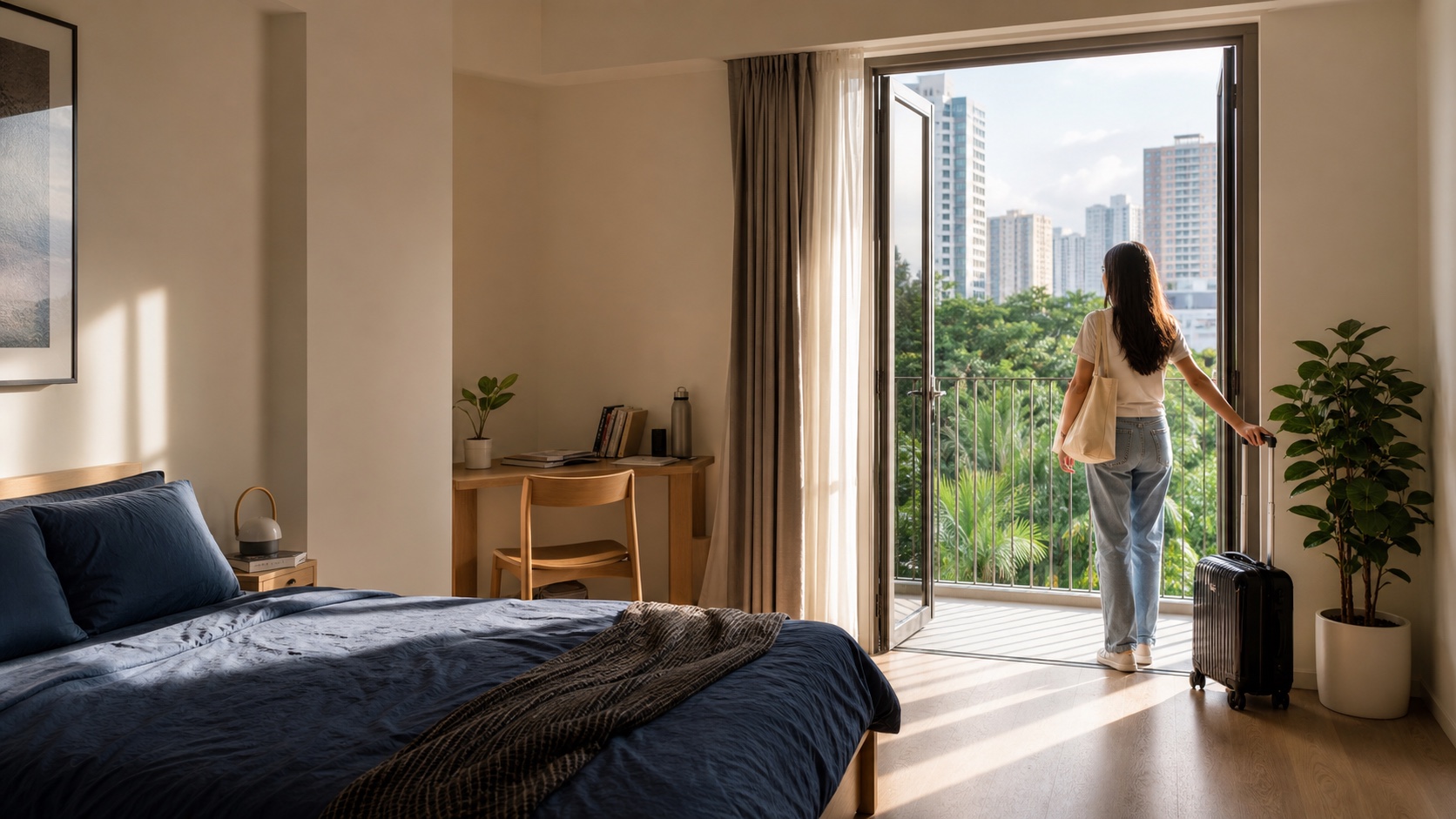
Unlike Vietnam, where the law is quite open in house rental transactions, the form of house rental in Singapore is bound by many factors such as mandatory stay period, steps to sign LOI, contract, etc.
So how can you find a suitable living space, optimize costs and still avoid scams?
In this article, TuanSing will help you answer all the information. If you intend to study abroad or work in Singapore, don't miss this guide to renting a house in Singapore!
Table of Contents
Types of house rentals in Singapore
Social housing (HDB – Housing & Development Board)
For those who have just arrived in Singapore, you may wonder the concept of "What is an HDB house in Singapore?". HDB (short for Housing & Development Board) is social housing built and managed by the Singapore government. More than 80% of Singapore's population lives in these houses.
Characteristics:
Has a very diverse area (from 45 m² to more than 120 m²)
Always planned in sync with the infrastructure: near MRT train stations, supermarkets, food centers (Hawker Center) and other public amenities.
Advantages: Cheapest cost among apartment types, convenient location for daily living.
Disadvantages: Limited internal amenities such as swimming pool, gym,... and relatively noisy, less privacy.
Private apartment (Condominium / Condo)
Condominium / Condo are high-end apartment complexes developed by large private real estate corporations (such as CapitaLand, City Developments Limited,...), targeting the segment of residents with moderate to high incomes and the expat community.
Features: Security fence, 24/7 guard; Fully integrated with free amenities such as swimming pool, gym, tennis court, BBQ area and green campus.
Advantages: Modern living environment, private, quiet and absolutely secure.
Disadvantages: Not the most cost-effective among housing rental options in Singapore, especially for low-income people, students,...
Landed Property
This group includes townhouses (Terrace), semi-detached houses (Semi-Detached) or single villas (Bungalow), suitable for large groups of people (multi-generational families, large friends) who want to live together.
Features: Extremely spacious space, private garden. Sometimes landlords or brokers will divide the rooms in the real estate into individual rooms for individual rent.
Advantages: The most spacious and private space among rental options in Singapore.
Disadvantages: Extremely high cost, while the location is often far from train stations, supermarkets,...
Cost of renting a house in Singapore
HDB Singapore house prices for reference
Single room rental: 800 - 2,000 SGD/month.
Renting an entire house: 2,000 - 6,000 SGD/month (depending on number of rooms and location).
Condo rental price for reference
Singapore apartment rental costs vary depending on the level of amenities:
Renting a single room (Common Room - sharing bathroom): About 1,200 - 1,800 SGD/month.
Rent a large room (Master Room - with private bathroom): About 1,800 - 2,500+ SGD/month.
Rent an entire house (Studio or 1-2 bedrooms): From 3,500 to more than 6,000 SGD/month depending on location (in the central CBD area, prices will be much higher than in the suburbs).
Land/townhouse rental price for reference
When renting individual rooms in townhouses, the price will vary depending on the type of room you choose:
Common Room (Regular room, shared bathroom): 900 - 1,400 SGD/month (depending on area).
Master Room (Large room, private bathroom): 1,500 - 2,500 SGD/month.
Where to find houses to rent in Singapore?
The development of the Internet and real estate services makes finding a place to rent a house in Singapore extremely easy and diverse. You may consider the following channels:
Major Real Estate Sites
PropertyGuru (propertyguru.com.sg): Singapore's largest and most reputable real estate website. The most special feature is that thanks to the detailed filter, you can find and classify rooms by type (HDB/Condo), price, number of bedrooms, location near any MRT station or area,...
99.co: PropertyGuru's major competitor. But having a live map makes it easier to visualize the home's location relative to work or school.
RentInSingapore (rentinsingapore.com.sg): Useful source of rental information in Singapore, focusing on the single room rental segment (Common Room/Master Room), very suitable for working individuals or international students looking for a shared room.
Social Network groups
If you want to find a room quickly or easily communicate in Vietnamese, you should choose Facebook groups with an active Vietnamese community.
Example Facebook Groups:
Find Rooms for Rent in Singapore
Vietnamese Community in Singapore (Where many international students and working people give up their rooms or find people to share a room with).
Property / Rooms For Rent / Sale ♥ Singapore
Through the above groups, you not only can easily ask and answer questions but also have the opportunity to find people to live with who are fellow countrymen. However, you need to be wary of widespread scams.
Co-living service
To rent a house in Singapore cheaply without much effort, learn about Co-living, a model of renting a room in a large apartment, managed by a company. Normally, each resident has their own room but shares the living room and kitchen space.
Refer to platforms such as The Coliwoo, Hmlet (Habyt), Cove, Figment.
The rental price usually includes all electricity, water, internet, and cleaning services. Flexible contract (from 3 months), does not cause you to have disputes with the landlord. The rooms are always decorated very modern and youthful.
Introduction from friends/relatives
Compared to the above channels for finding a place to rent a house in Singapore, asking friends/relatives who have lived in Singapore for a long time has many advantages such as: saving time, saving effort in searching and contacting.
However, your friends/relatives may only understand the area they live in or the house segment they are renting. However, you can ask them to help you check the room.
Real estate broker
If you have just arrived, are not good at English, and are too worried about finding a place to rent a house in Singapore, choosing a real estate broker is quite ideal. They will find a house according to your requirements.
You can go to the websites of Singapore room rental brokers such as ERA, PropNex, Huttons, or OrangeTee to find contact information.
Be aware of brokerage fees. As a rule, if you rent a whole house long-term (usually 2 years or more), the landlord will pay a brokerage fee. If the contract is less than 1 year or the value of the rented room is low, you may have to pay a brokerage fee equal to half a month or 1 month's rent. Always ask about this cost carefully before viewing a house.
How to rent a house in Singapore cheaply and avoid scams
Prioritize the form of shared accommodation
When living together, the rental price for a Singapore Master room (with private bathroom) is always more expensive than a Common room (with shared bathroom). If you live alone, choosing a Common Room will save a large amount of money.
Or you can rent a large Common room and share 2 people (if the landlord allows). This helps you cut your rent in half.
Do not set high criteria for position
There is a golden rule: "The closer to the MRT, the more expensive it is." Apartments 2–3 minutes walk from MRT always have outstanding prices. However, if you downgrade to apartments that are about a 10-15 minute walk from the MRT, or have to take a short bus ride to the MRT station, the rental price will "cool down" by 15% - 20%.
On the other hand, remember to avoid central (CBD) and upscale areas. It is better to prioritize houses in suburban or near-central areas such as Woodlands, Yishun, Jurong West, Punggol, Pasir Ris. Not only the house rental price in Singapore, but the cost of meals at Hawker Centers is also much cheaper.
Consider long-term rental
A 2-year contract always has a better monthly rental price than a 1-year contract. If you are determined to stay stable, boldly sign a 2-year contract.
Be careful when pre-staking
House rental scams in Singapore are very sophisticated. Therefore, absolutely do not transfer a deposit in advance, no matter how attractive the room is, before stepping foot in the house (or without asking friends or relatives to come and see it in person).
Verify the broker's identity
All legal real estate brokers in Singapore are required to register with the CEA.
The easiest way to verify the reputation of your Singapore rental broker is to ask them for their Full Name, Registered Phone Number and CEA Registration Number (e.g. R123456A).
Then, you access the official website: CEA Public Register to look up whether the information matches.
Evaluate the homeowner's reputation
If the person posting claims to be the homeowner, you have the right to ask them for proof. by asking to see your My HDBPage account (if it is an HDB house) or the house ownership certificate/Property Tax Bill with the name and address of the house printed.
Standard house rental process in Singapore 2026
Step 1: Find a room
Search for places to rent rooms in Singapore through reputable channels and Facebook groups.
During the process of filtering information, clearly determine your needs: Common Room or Master Room, living in HDB or Condo, whether there is a common owner or not, travel time to work/school. From there, make a list of at least 3–5 most satisfactory apartments.
Step 2: See the room directly
This is a mandatory step that cannot be skipped, because sometimes the room on the photo may be different from reality. If you are in Vietnam, ask relatives or friends to come watch, or ask the landlord/broker to make a live video call, filming the Singapore rental location.
Suggested Checklist for checking your room:
Facilities: Air conditioning (operability), water pressure in the toilet, mattress and wardrobe are not moldy.
Living environment: Who are the housemates, are they neat, what are the cooking rules?
Note: Absolutely do not deposit before viewing the house.
Step 3: Express your intention to rent & Make a reservation deposit
When renting a Singapore house through a broker, you are required to sign an LOI, a document expressing your commitment to rent the room with specific conditions (proposed price, move-in date, repair requirements if any).
In addition, you will transfer 1 month's rent to "reserve your place". Once the homeowner has signed the LOI, they are not allowed to rent to anyone else and the money will automatically be converted into a deposit. If the landlord refuses the LOI, they must refund 100% of the amount.
However, if working directly from the homeowner, the LOI can be omitted.
Step 4: Sign the rental contract
The most important thing is to read each term carefully before signing a rental contract in Singapore.
Suggested Checklist to check for you:
Diplomatic Terms: Extremely important for foreigners. If you lose your job, lose your visa card (EP/Spass/Student Pass) and have to leave Singapore, this clause allows you to terminate the contract early (usually after 12 months) without losing your deposit.
Minor repair clause: Specifies the limit you must pay yourself when there is a minor damage due to natural wear and tear (usually the first 150 - 200 SGD for each incident, the excess will be paid by the homeowner).
PUB and Wifi bills: Clearly state whether electricity, water, and internet bills are fixed or divided equally per person.
Minimum term: Ensure legal recording (minimum 6 months for HDB, 3 months for Condo).
Step 5: Pay Contract Tax
A house rental contract in Singapore is only legally valid in court when Stamp Duty has been paid.
In principle, the tenant (you) must bear this cost. Tax is about 0.4% of the total contract value (for example: room 1,000 SGD/month, 1 year contract => Tax about 48 SGD).
The broker or homeowner will complete the online procedures on the IRAS system and send you the original Stamp Duty Receipt (Stamp Certificate) with a public lookup code.
Step 6: Check in and prepare handover records
On move-in day, check-in and final inspection will be conducted. All assets the homeowner hands over to you (beds, wardrobes, mattresses, air conditioners, door locks...) are included in the Inventory List.
Your job is to take detailed photos and videos of every scratch on the wall, stain on the mattress, or existing damage, to send to the homeowner/realtor as evidence. Otherwise, when you check out, they may deduct your deposit for damages not caused by you.
Answers to frequently asked questions when renting a house in Singapore
What is the minimum length of time required to rent a house in Singapore?
For HDB houses, minimum 6 months and for Condos, minimum 3 months. Any form of daily or weekly rental of these two types is illegal and the tenant can be evicted.
When renting an apartment in Singapore, how many people can stay maximum?
A regular HDB or Condo apartment is only allowed to have a maximum of 6 people living (excluding direct family relations) to avoid housing overload in Singapore.
Are rent prices in Singapore high?
Housing prices in Singapore are among the most expensive in the world and the highest in the Asia-Pacific region (surpassing Hong Kong).
Therefore, to save costs, both working people and students should consider HDB housing.
Who pays the PUB fee?
PUB (short for Public Utilities Board, includes electricity, water, and gas), Internet (Wifi) fees are usually paid by the tenant, but the form of payment will be different depending on whether you rent an individual room or rent an entire house.
If you rent a shared house in Singapore, the total cost is divided per person, about 50 - 100 SGD/month/person.
What should you keep in mind about cooking regulations when renting a house in Singapore?
Many landlords only allow light cooking such as cooking noodles, boiling eggs, boiling water, and completely prohibit frying, stir-frying, and cooking foods with strong odors (such as fish sauce, curry) when renting a house in Singapore.
If you have a habit of cooking for yourself to save money, ask carefully and request that the "Heavy cooking allowed" clause be included in the rental contract in Singapore to avoid disputes.
What is the Ethnic Quota (EIP) when renting a house in Singapore?
The Singapore government sets a maximum percentage for each ethnic group (Chinese, Malay, Indian and other minorities/Foreigners) allowed to live in each building and each block.
If the ethnic group quota at a building is full, the HDB system will immediately refuse to approve a rental contract in Singapore.
Conclusion
In short, renting a house in Singapore offers many options such as HDB houses, Condos, townhouses, etc. However, house rental prices in Singapore vary depending on the type of house, geographical location, level of amenities, etc.
If you are an international student or new worker coming to Singapore, please carefully study the above information, as well as prioritize choosing a reputable source of information to find a house, and read the contract carefully before signing.
Hope the above set of tips will help you! Don't forget to contact TuanSing if you have any further questions!