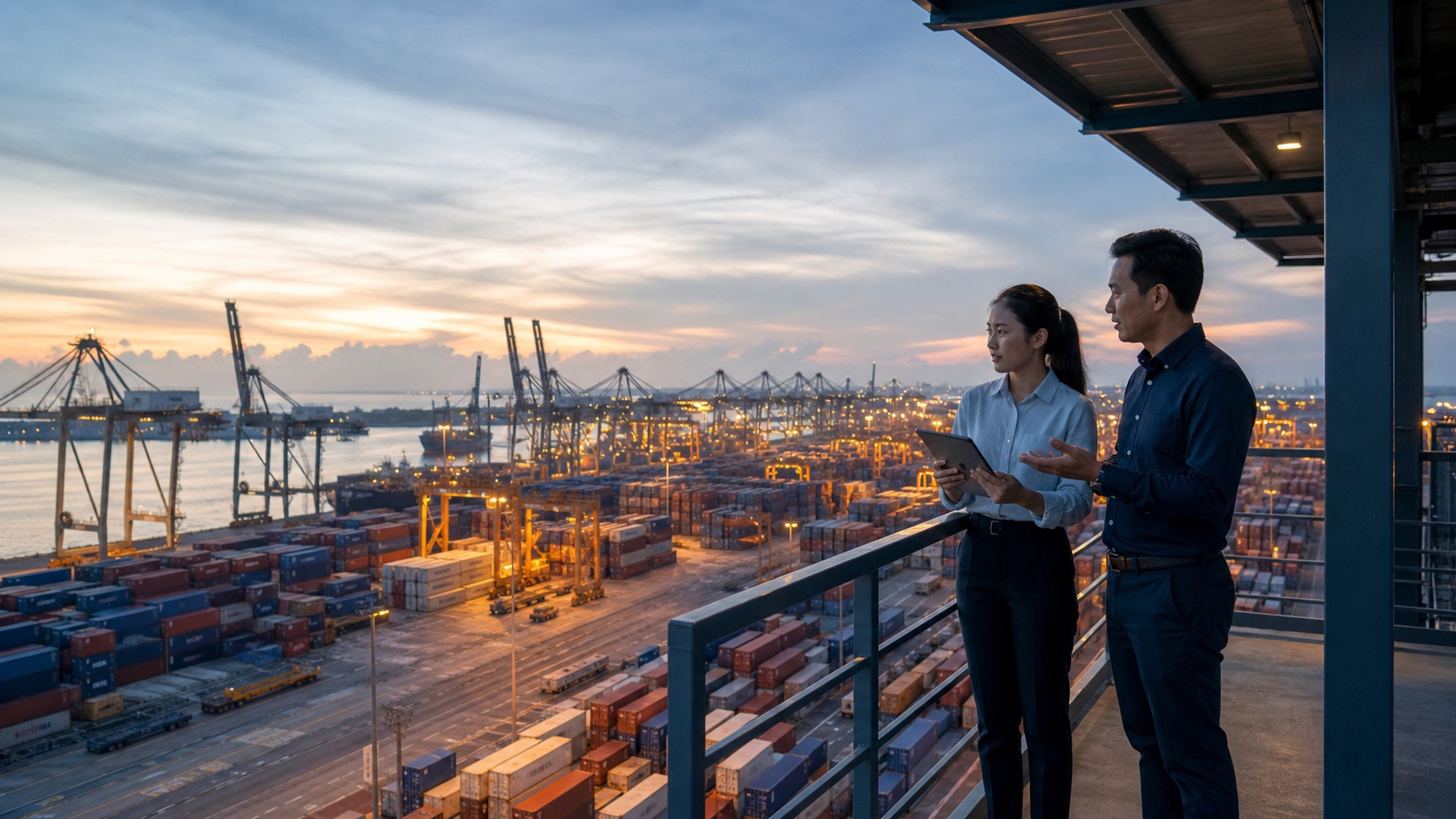
In the context of the global supply chain moving strongly to Southeast Asia in 2026, studying Logistics in Singapore is not just a study option, but an opportunity to work with a high salary at a prestigious corporation, observing the reality of smart logistics and automated seaports right in everyday life.
But where to start? Should I choose an international standard university system or the 6+6 paid internship route to save costs? All will be answered soon!
Table of Contents
Why should you study Logistics in Singapore?
Known as the world's leading Logistics center, studying Logistics in Singapore not only brings book knowledge, but above all, the opportunity to observe reality and practice.
And no other country can do that. All thanks to the great advantages of the Lion Island.
Advantages of location and Logistics activities
If you have ever researched, you certainly know about the Port of Singapore (PSA), one of the busiest transshipment ports in the world. Located at the Strait of Malacca, the vital gateway connecting the Indian Ocean and the Pacific Ocean.
In addition, Singapore is also home to Changi Airport and the top-performing Changi Airfreight Center, and brings together more than 20/25 of the world's leading Logistics companies (such as DHL, DB Schenker, FedEx, Kuehne+Nagel).
In addition, below are some other advantages of studying Logistics in Singapore:
High-tech application learning program
Bachelor's programs at private schools affiliated with British and Australian Universities (such as SIM, Kaplan, Curtin, James Cook) usually last from 2 to 2.5 years, helping you graduate and go to work sooner.
Studying Logistics in Singapore opens up modern concepts such as Automation, Artificial Intelligence (AI) in supply chain forecasting, Green Logistics, and Blockchain in bill of lading management.
Attractive job opportunities
Always among the industries that need high-quality human resources, studying Logistics in Singapore and performing well in the internship is the shortest path to receive a work visa offer (S Pass/E Pass).
Whether you plan to transfer to European or American countries or return to advance in Vietnam, this valuable work experience is always valuable.
Save costs
The total cost of studying Logistics in Singapore is estimated to be 30-40% more economical than Western countries, while the degrees received are completely equivalent.
On the other hand, because Singapore is close to Vietnam, it only takes about 2-3 hours by flight to visit home or maintain personal connections.
Conditions for studying Logistics in Singapore
Conditions for admission to public schools (NUS, NTU, SUSS, NYP...)
Leading universities such as NUS (National University of Singapore) or NTU (Nanyang Technological University) have extremely strict requirements:
Education: Graduated from high school with excellent academic results (average score of 9.0 or higher) and have a national certificate such as GCE A-Level or IB International Baccalaureate diploma.
English: IELTS score from 6.5 - 7.0 or equivalent TOEFL.
Standardized test: SAT score (minimum requirement usually ranges from 1250 - 1400 depending on industry) or ACT (GMAT/GRE if studying for a Master's degree).
Conditions for admission to Private & International schools (SIM, Kaplan, Curtin, JCU, STEi...)
For Bachelor's degree:
Education: Graduated from high school (GPA 6.5 - 7.0 or higher) or completed a College course (Diploma) in a related field in Singapore.
Foreign language: IELTS from 6.0 (no skill below 5.5).
For Master's degree:
Education: Graduated from University in Vietnam or Singapore (does not have to major in Logistics, some schools accept similar majors or require additional courses).
Foreign language: IELTS from 6.0 - 6.5.
Work experience: Usually not required for the private sector, but having 1–2 years of experience in logistics, purchasing, and supply chain will be a big advantage when considering applications.
Cost of studying Logistics in Singapore
The cost of studying Logistics in Singapore can be divided into three main expenses as follows:
Tuition
Tuition fees to study Logistics in Singapore range from 15,000 - 39,000 SGD/year (about 280 - 730 million VND) at Public schools (NUS, NTU, SMU) and 15,000 - 52,000 SGD for the entire course depending on the training system at Private & International schools (Kaplan, Curtin, SIM, ERC).
Living expenses
Singapore is famous for being an expensive country, but international students can spend reasonably if they know how to manage their finances. Average living expenses will range from 1,200 - 1,800 SGD/month (about 24 - 36 million VND). In which:
Shared room (sharing 2-4 people in a dormitory or HDB apartment): 600 - 800 SGD/person.
Single room: 900 – 1,200 SGD.
If you eat at popular food courts (Hawker Center, Food Court), each meal costs about 5 - 7 SGD. If you take the time to go to popular supermarkets like Sheng Siong and FairPrice to cook for yourself, the cost will be significantly reduced.
Travel (MRT & Bus): 80 - 150 SGD/month (use EZ-Link card to swipe in turns, very convenient and cheap).
Phone, Internet, electricity and water: 80 - 150 SGD/month.
Personal expenses, entertainment: 100 - 200 SGD/month.
Procedure costs (in Vietnam & Singapore)
Before flying and when living in Singapore, studying Logistics in Singapore requires preparing the following paperwork:
Desired registration fee: 200 - 550 SGD (depending on the school, some occasions this fee will be waived).
Student Pass fee: 90 SGD to be paid to the Immigration Department (ICA).
Compulsory medical examination in Singapore: 40 - 70 SGD.
Student health insurance: 150 - 300 SGD/year.
One-way flight ticket Vietnam - Singapore: 3 - 5 million VND.
Can I apply for a scholarship to study Logistics in Singapore?
It is absolutely POSSIBLE to get a scholarship to study Logistics in Singapore. Even because it is the economic backbone of the country, the government and schools always have open scholarship and financial support policies to attract talented people.
Normally, there are 3 sources to apply for scholarships to study Logistics in Singapore. These are:
From Private & International Schools
This source is considered the easiest to find, because of its popularity and direct approval based on academic records (GPA) and English (IELTS) in Vietnam. In particular, the school does not require a commitment to stay and work after graduation.
Currently, there are typical rates such as:
Award (Academic/Merit Scholarship) from Curtin University Singapore, worth 25% - 30% tuition for the entire Bachelor of Commerce program (majoring in Logistics in Singapore and Supply Chain Management).
SIM GE Merit Scholarship or SIM STARRR Award from the Singapore Academy of Management (SIM GE), fixed funding of up to 15,000 SGD (about 300 million VND) for excellent students with high GPA and IELTS, exciting extracurricular activities (CCA) and leadership qualities.
From public schools
Among the sources of scholarships to study Logistics in Singapore, those awarded by leading public universities such as NUS, NTU, SUTD, and SUSS are often the most competitive.
If your application is successful, you will receive funding of about 50% - 60% of tuition fees throughout your university years. However, there is a condition that after graduation, you must stay and work for a company registered in Singapore for 3 years.
From large corporations in the industry
With the roadmap to study Logistics in Singapore and prove your ability, you can absolutely consider applying for:
Singapore Seaport Corporation Scholarship (PSA Undergraduate Scholarship): PSA is always looking for talent to operate the global supply chain. This scholarship covers full tuition and a periodic living allowance, along with internship conditions and a commitment to work at PSA after graduation.
Singapore Maritime Foundation Scholarship (MaritimeONE Scholarship): Usually sponsors students studying majors related to maritime logistics and shipping.
Should I study Logistics in Singapore under the 6+6 system or University?
Currently, studying abroad in Singapore for the 6+6 system is emerging as a trend, with 6 months of specialized theoretical study at school and 6 months of paid internships at businesses.
Meanwhile, the traditional university course lasts continuously for 2 to 3 years (depending on public or private school).
Many international students tend to wonder between these two options. However, each side has its own advantages and disadvantages:
Study Logistics in Singapore according to the 6+6 system
Characteristics:
Degree: Advanced College (granted by Singapore school)
Study duration: 1 year (6 months theory + 6 months internship)
Entry requirements: Extremely easy. Graduated from high school (or finished grade 10/11 depending on the school), IELTS from 4.5 - 5.5 (or take the school's test).
Tuition: Very cheap. About 8,000 - 12,000 SGD (160 - 240 million VND) for the entire course.
Income: Receive internship salary for 6 months (about 800 - 1,200 SGD/month).
Opportunity to settle down: Average. Having difficulty applying for an executive visa (E-Pass) right away.
In short, this system has the advantage of saving maximum costs and immediately accumulating 6 months of practical work experience while still in school. But the downside is that the degree stops at the Advanced College level. If you later want to advance to senior management positions (Manager, Director), you are required to study at university.
Study Logistics in Singapore at University level
Characteristics:
Degree: Bachelor's degree (Bachelor - issued by British/Australian school or Public University)
Study time: 2 - 2.5 years (Private system) or 3 - 4 years (Public system).
Entry requirements: More difficult than 6+6. Graduated from high school with good/good GPA, IELTS from 6.0 - 6.5.
Tuition: Average/High. About 35,000 - 50,000 SGD (700 million - 1 billion VND) for the entire course.
Income: None. Singapore law prohibits private students from working part-time.
Opportunity to settle down: High. An international bachelor's degree helps you easily negotiate a high salary to qualify for S-Pass or E-Pass approval from the Singapore Ministry of Manpower (MOM).
In short, the advantage of this route is that it provides an international standard Bachelor's degree, making it easy to apply for a job anywhere. But the disadvantages are high initial investment costs, long study time and not being able to work part-time during the study period.
Conclusion
Studying Logistics in Singapore brings many employment advantages, thanks to gathering more than 20/25 of the world's leading Logistics companies (such as DHL, DB Schenker,...), and the opportunity to settle down because working in an industry that lacks human resources.
Depending on the system you choose, you can save significant study costs and gain more work experience.
If you still have any questions or have not determined a suitable route, contact tuansing immediately for a free consultation!